The impulse response. This is something I learned in my Systems and Signals class, but I really think it’s fascinating enough to get its own blog post.
What is an impulse response? I would like to think of it as a system’s blueprint. All you do is give the system a short burst of energy, a very quick poke, and how the system responds to it is the impulse response. This singular response will tell you how the system would respond to ANYTHING.
Impulse Signal
To get the impulse response, we need to give it some input. This input is what we call the impulse signal or the IMPULSE. In math, we call it the Dirac Delta function, written as \(\delta(t)\). The Dirac Delta is defined as:
\(\delta(t)\) = 0 for all t \(\neq\) 0 and \(\int_{-\infty}^{\infty} \delta(t) \,dt = 1\)
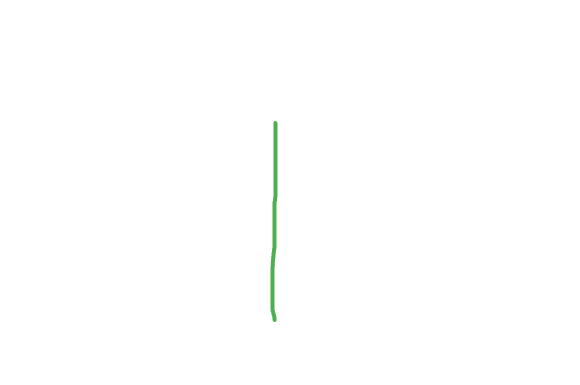
It can be of any width or length (as long as the area is 1), but I like to think of it using the above representation. Physically, the perfect impulse is not possible, but we can come very close to it. There are many practical approximations that work great for most real systems.
Impulse Response h(t)
When you feed a Dirac Delta into a LTI (Linear Time Invarient) system, you get an impulse response output h(t).
system input: \(x(t) = \delta(t)\)
system output: \(y(t) = h(t)\)
Linearity & Time Invarience
It’s very important to note that the system is LTI. Now what does LTI mean exactly? First for linearity. If we have ‘input 1’ and ‘input 2’ of the system, they produce ‘output 1’ and ‘ouput 2’. A linear system would be one that follows the rule that the outputs summed equals the output we get when we put in an input that’s the inputs summed. Aka: y1 + y2 = (x1 + x2). Next for time invarience. Let’s say you flip a switch, and the lightbulb turns blue. You come back a few minutes later, and flip the switch again. It still lights up blue. This means it’s time invarient, as the output (the lightbulb’s color), doesn’t vary with time. Even if you turned on the lightbulb a 10 years from now, it’ll still turn blue.
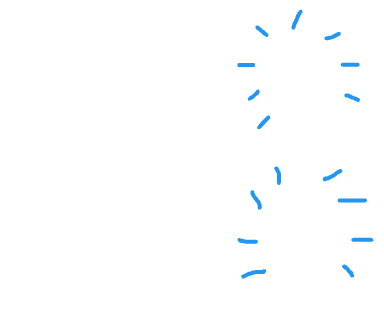
These properties are so important because it says that any input could be decomposed into individual impulses, and all those impulses added up give the output.
In fact, we can give this an exact value using an integral:
\[x(t) = \int_{}^{} x(\tau) \delta(t-\tau) \,d\tau\]
Convolution
We now apply it to an LTI system. Since it’s linear, each scaled impulse produces a scaled impulse response at the output. Since it’s time invarient, the impulse response to a delayed impulse is just a delayed h(t):
\[y(t) = \int_{}^{} x(\tau) h(t-\tau) \,d\tau\]
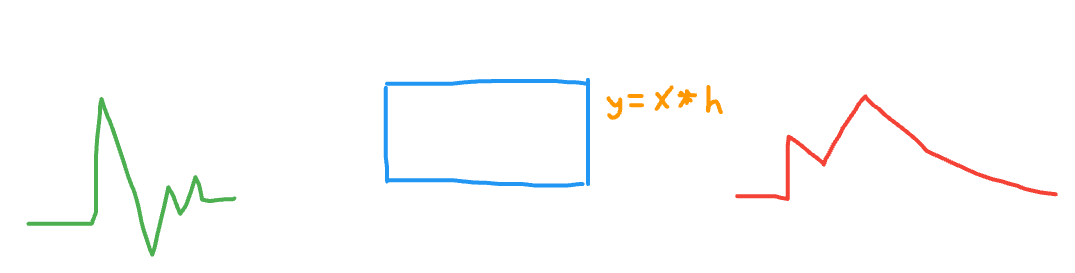
\[y(t) = x(t) * h(t)\]
The second line is a very important concept called Convolution. If we know h(t), we can find the output for any input forever! It looks something like this:
Stability
Other than predicting outputs, the impulse response can also tell us if a system is stable or unstable. What do we mean by this? We can define a stable system as BIBO stable, as in Bounded Input and Bounded Output. Basically, if the impulse signal eventually decays to 0, the system is stable. But, if it grows or oscillates without ever dying out, it is unstable (bounded inputs producing unbounded outputs). We can see what happens to the overall system just by looking at the impulse response over time.
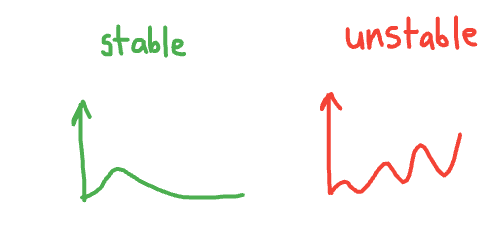
In real life, we can see many examples of unstable impulse responses. For example, a bridge that sways wider for every gust of wind, eventually leading to failure.
Conclusion
The impulse response is truly so interesting as it takes advantage of very basic and simple characteristics of linear systems. That is, they can’t create new frequencies and they don’t interact with themselves in unpredictable ways across time. To understand a system, we don’t need to set a thousand conditions and study how it reacts to each one of them. We just need to do it once and see what happens.
Thanks for reading everyone! I hope you found this topic as interesting as I did. Please let me know your thoughts :)